
Design research, interview studies, synthesis, UX Design, Information ARCHITECTURETurning a logistics nightmare into a 20% efficiency boost
Role: Lead Product Designer, Researcher & Strategist
Outcome: $127k/year in projected time savings & 63% reduction in manual data entry.
The Problem Logistics agents were drowning in data. The client's trailer management system was fragmented across disparate tools, forcing agents to rely on memory and manual reconciliation.
The Friction: reconciling data took 87 minutes/day.
The Risk: "Lost" trailers and missed revenue opportunities.
The Reality: Agents were overwhelmed by cognitive load, leading to a high error rate.
The Strategy Don't just pretty up the interface. Fix the workflow. I didn't just "refresh" the UI; I restructured the data model to match how agents actually think.
Cognitive Load Reduction: We moved from a "one-size-fits-none" table to specialized views (Map, Grouped, List) that align with specific tasks.
Communication as Infrastructure: We elevated comments and notifications from "nice-to-haves" to core infrastructure, replacing external emails with in-context history.
Systematized Consistency: Created a shared visual language that reduced training time for new agents.
Logistics management platform design / Fleet management UX design / Transportation software interface design / B2B logistics web applicationProcess
✦
research
✦
competitive audit
✦
wireframes
✦
prototype
✦
review
✦
implement
✦
measure
✦ research ✦ competitive audit ✦ wireframes ✦ prototype ✦ review ✦ implement ✦ measure
Research
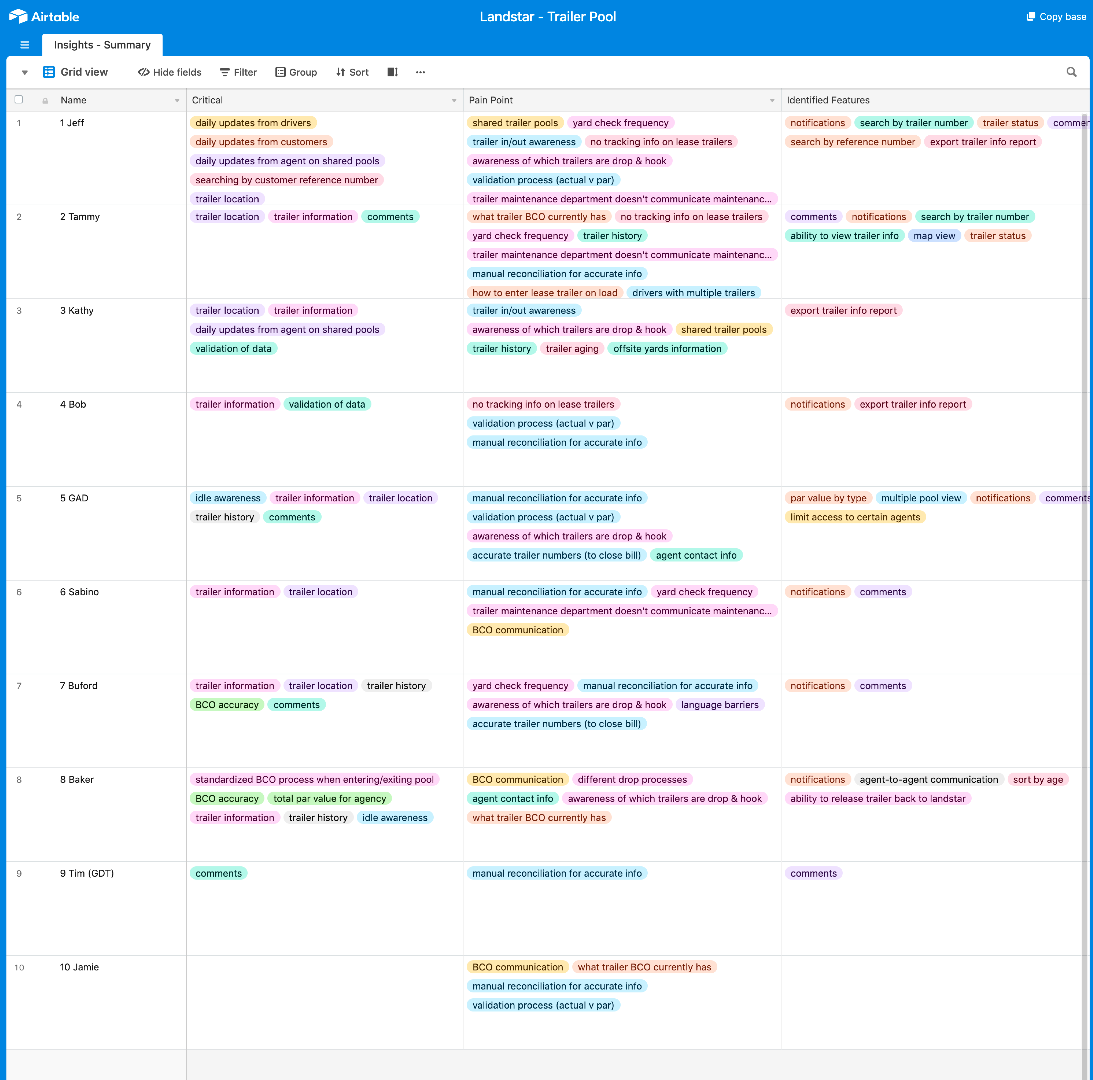
The team conducted comprehensive user interviews with 10 stakeholders to identify critical pain points and workflows. Research data was visualized in Airtable, revealing patterns that informed design priorities.
The design approach centered on addressing cognitive overload—recognizing that when working memory receives more information than it can handle, users experience frustration and make more errors.
Core Problems
Inconsistent systems and processes for trailer pool management
Different customers requiring different reports and information
Communication bottlenecks, especially in agent-to-agent communication and trailer maintenance departments
Design Strategy
Empower end users with complete trailer knowledge
Make changes and required actions immediately visible
Create shared processes to minimize overhead
Mitigate cognitive overload and reduce reliance on working memory
Final Prototype
best viewed on tablet or desktopKey Concepts
Grouped View
Managing pools, not just individual units.
Pool Quickview
Details on demand without breaking flow.
Pool Detail View
Details and tracking, centralized.
Map View
Geographic context at a glance.
Future Vision
The long-term roadmap included:
Dashboard approach for pool status overview
Real-time trailer-level comments feed
Seamless backend integration with other agents, BCOs, and Landstar systems
Automated data inputs to reduce manual reconciliation
Retrospective
Features don't solve problems; workflows do. The breakthrough wasn't a specific UI element, but the decision to stop forcing users to memorize data and start letting the system do the heavy lifting.
“This is night and day from what we had before. I can actually see what’s happening with my pools without calling ten different people.”
“The group view saved my life during peak season. I could manage 30% more pools without working overtime.”
Business results, measured
We didn't just ship it; we measured it against a 3-month baseline.
Efficiency: 63% reduction in manual reconciliation time (87m → 32m).
Speed: 78% faster trailer lookup (54s → 12s).
Accuracy: 52% reduction in data entry errors.
Adoption: Daily active usage jumped from 68% to 94%.
“Finally, a system that thinks like I think. The map view alone cut my morning review time in half.”